

Technical/scientific Challenge:
Modern traffic monitoring systems generate extremely large volumes of heterogeneous data originating from distributed camera infrastructures, sensor systems, and traffic monitoring platforms. Each camera stream or sensor node produces continuous data describing vehicle movements, speed patterns, traffic density, and vehicle classifications. As the number of monitoring points increases across national and international road networks, the resulting datasets quickly reach scales that require high-performance data analytics approaches.
One of the main challenges is the efficient processing and interpretation of this high-frequency traffic data while maintaining strict anonymization and privacy guarantees. The company must transform raw observational data into structured traffic intelligence products that can be safely shared with partners such as infrastructure planners, mobility service providers, and logistics companies.
Another challenge arises from the need to analyze traffic patterns at multiple levels simultaneously. Analysts often need to combine spatial and temporal perspectives, identifying regional congestion patterns, detecting unusual traffic behavior, and comparing vehicle flows across different time periods or geographic areas. Performing such analyses manually or through isolated scripts leads to fragmented workflows and limited scalability.
In addition, the rapid growth of traffic datasets introduces computational complexity. Real-time or near-real-time analytics requires parallel processing of large data streams, efficient data pipelines, and scalable AI-driven analysis capable of detecting patterns, anomalies, and mobility trends across large road networks.
To address these challenges, a structured analytical environment capable of orchestrating multiple analytical tools and computational processes is required. Such an environment must ensure reproducibility of analyses, efficient use of HPC resources, and controlled interaction between AI models and large-scale traffic datasets.
Solution:
To support high-speed traffic data analysis, a multi-agent AI workflow orchestrated through the Model Context Protocol (MCP) was designed and implemented. The system integrates large-scale traffic datasets with analytical tools capable of performing automated traffic pattern analysis, anomaly detection, and infrastructure performance monitoring.
The MCP layer acts as a coordination mechanism between the user interface and the analytical components. Instead of performing isolated analysis steps, MCP enables structured orchestration of specialized agents that execute analytical tasks in a controlled sequence.
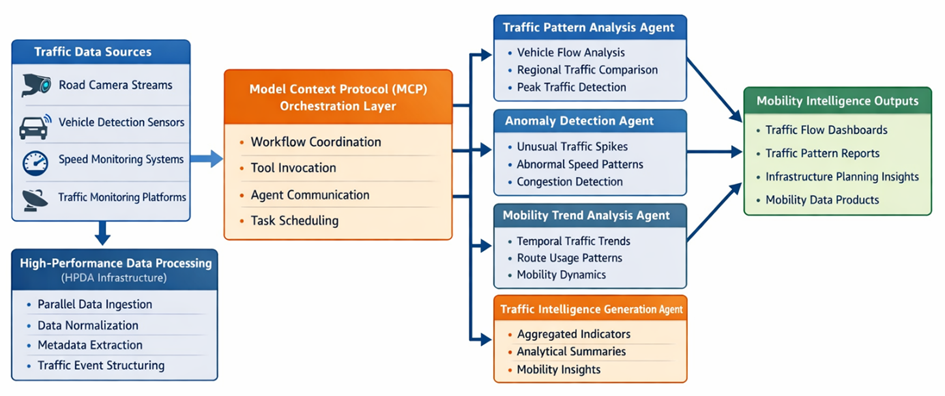
Figure 1. Architecture of the AI-orchestrated traffic data intelligence system. Traffic data collected from distributed camera infrastructures and sensor platforms are processed through high-performance data processing pipelines. The Model Context Protocol (MCP).
The implemented architecture includes several coordinated analytical components:
- Traffic Data Processing Agent
The first component is responsible for ingesting and preparing traffic datasets collected from distributed camera systems. Data streams describing vehicle types, speeds, and traffic intensity are normalized and structured into analytical datasets suitable for large-scale processing. Parallel data pipelines ensure that large volumes of incoming data can be processed efficiently using HPDA infrastructure.
- Traffic Pattern Analysis
Once prepared, the datasets are analyzed to identify traffic patterns across different locations and time periods. Analytical routines examine traffic density, vehicle distribution, and speed profiles to identify mobility trends and regional variations in traffic intensity. These analyses support the creation of structured reports describing traffic flows across the monitored road network.
- AI-Based Anomaly Detection
AI-driven anomaly detection methods are applied to identify unusual traffic behavior, such as sudden congestion spikes, abnormal speed distributions, or irregular vehicle flow patterns. Detecting such anomalies is valuable for identifying incidents, infrastructure bottlenecks, or unexpected traffic events that may require further investigation.
- Mobility Intelligence Generation
The final stage of the workflow transforms analytical output into interpretable mobility intelligence products. These include aggregated indicators, traffic flow summaries, and analytical dashboards that can be used by transport planners, infrastructure managers, and commercial partners interested in mobility insights.
Through MCP orchestration, each analytical step is executed as part of a structured workflow, ensuring that analyses can be repeated consistently when new traffic datasets are collected or when additional monitoring locations are added.
Interaction with the system is performed through a natural-language interface, which allows analysts to initiate analytical workflows without manually configuring each computational step. The system automatically coordinates the required analytical tools and generates both narrative explanations and structured outputs.
Scientific impact:
The project contributes to several important research and technological directions:
- The implementation demonstrates how MCP can be used to coordinate multiple analytical components within a structured workflow, enabling repeatable analytics processes over large-scale traffic datasets.
- The work illustrates how HPC and HPDA infrastructures can support the processing of large-scale mobility data, enabling efficient handling of high-frequency traffic observations collected from distributed monitoring systems.
- By integrating AI-based anomaly detection and pattern recognition techniques, the system enables automated discovery of traffic trends and irregularities that may otherwise remain hidden in large datasets.
- The multi-agent design supports scalable analysis across expanding traffic monitoring networks, ensuring that the analytical environment can grow together with the data collection infrastructure.
- Although applied to traffic data intelligence, the MCP-based orchestration framework can also be adapted to other data-intensive domains such as smart city monitoring, logistics analytics, or infrastructure performance analysis.
Benefits:
The implementation of the MCP-orchestrated traffic analytics system provides several operational advantages:
- Faster processing of large-scale traffic datasets through parallel HPDA infrastructure.
- Automated identification of traffic patterns and anomalies across distributed monitoring locations.
- Improved scalability of analytical workflows as new cameras and monitoring points are added.
- Reduced manual effort in performing complex traffic analyses.
- Generation of structured mobility intelligence products that can support infrastructure planning and transport optimization.
- Improved reliability and reproducibility of traffic analytics processes through standardized analytical workflows.
Success story # Highlights:
- MCP-orchestrated AI analytics workflow for large-scale traffic data processing.
- Integration of distributed camera datasets into a unified analytical environment.
- AI-driven anomaly detection for identifying irregular traffic patterns.
- High-performance processing of mobility datasets using HPDA infrastructure.
- Scalable architecture supporting expanding traffic monitoring networks.
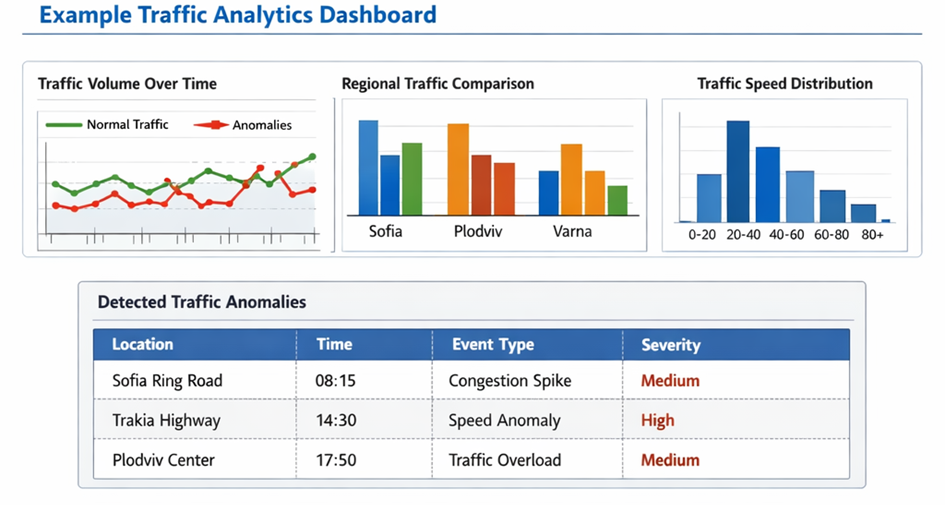
Figure 2. The dashboard presents traffic volume trends, regional traffic comparisons, speed distribution analysis, and detected traffic anomalies.
Contact:
- Chief Assist. Dr. Ivona Velkova, [email protected]
- Prof. Kamelia Stefanova, [email protected]
- Prof. Valentin Kisimov, [email protected]
University of National and World Economy, Bulgaria